Carmont Inquiry Told Victims’ Injuries Were Non-Survivable

A fatal accident inquiry has been told that the three men who lost their lives in a train derailment near Stonehaven sustained injuries that could not have been survived.
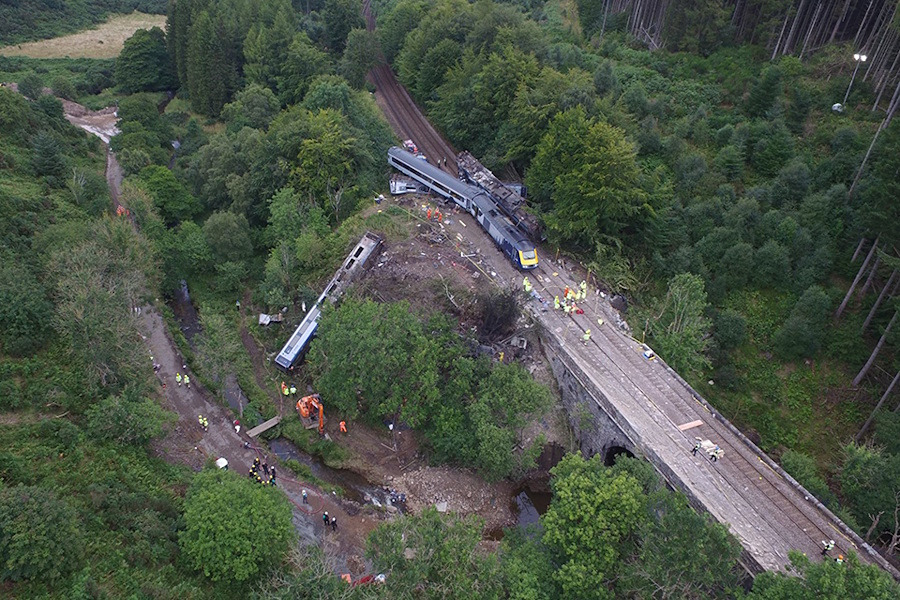
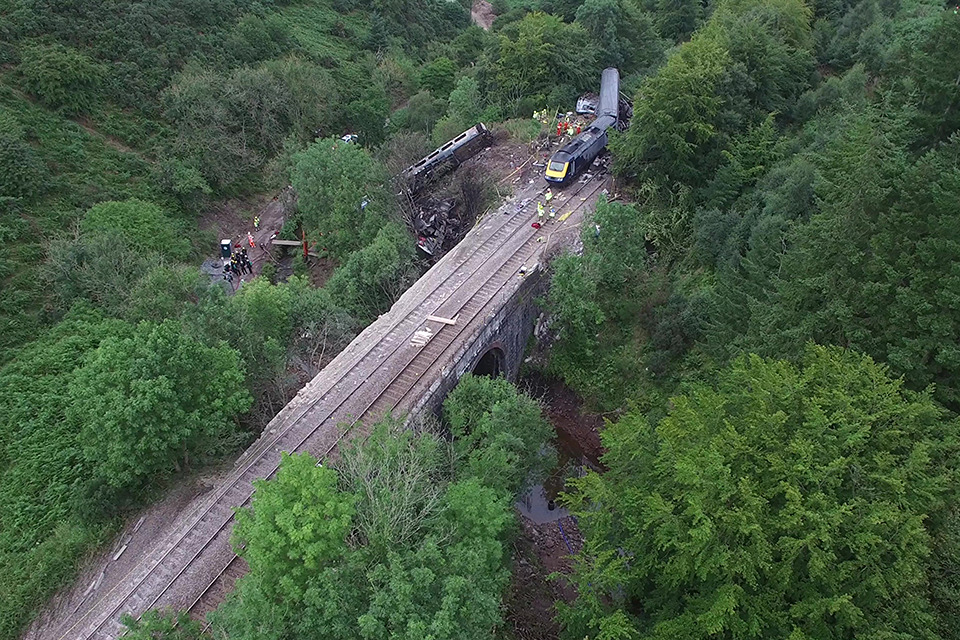
The inquiry, which opened at Aberdeen Sheriff Court on Monday, is examining the events surrounding the derailment at Carmont in Aberdeenshire on 12 August 2020. Those who died were train driver Brett McCullough, 45, conductor Donald Dinnie, 58, and passenger Christopher Stuchbury, 62. Six other people were injured when the ScotRail service travelling from Aberdeen to Glasgow Queen Street left the tracks after striking a landslide brought down by heavy rainfall.
The court heard that the force of the derailment threw Mr Stuchbury clear of the train. The body of Mr McCullough was later located on the lower section of the embankment, where carriages had come to rest after colliding with a bridge parapet. Mr Dinnie’s body was found trapped in the doorway of coach D and could not be recovered until the following day.
Alex Prentice KC, appearing as Crown counsel to the inquiry, told the court that post-mortem examinations revealed all three men suffered multiple blunt force injuries. Referring to a jointly agreed minute, he said the findings were clear.
Reading out the joint minute, he stated:
"It was judged that these injuries were non-survivable and death would likely have been immediate."
The inquiry also heard deeply personal statements from the families of the victims. Mr Prentice read extracts from a statement provided by Diane Stuchbury, the wife of Christopher Stuchbury, who explained that her husband was killed on the couple’s wedding anniversary.
Her statement read:
"Every day with Chris was a gift. The most loving, kind, wise, and loyal man you could ever wish to meet. The 12th of August used to be a special day in our house: the day we married."
Mrs Stuchbury said the derailment that claimed her husband’s life "should have never happened", adding that she and her family "have been robbed of their future together as a couple".
In a separate statement, Mr Dinnie’s family described the scale of their loss, telling the inquiry:
"He was loved and adored by all his family and friends. He will be forever missed."
Evidence was also heard about the emergency response to the crash. Fire crews arriving at the scene were faced with what was described as a “highly complex incident”, during which two firefighters were injured while carrying out rescue operations.
Nick Bucknall, an inspector of rail accidents with the Rail Accident Investigation Branch, explained that the train struck debris which had been washed onto the track from a drain following very heavy rainfall. The collision occurred at about 9.37am, with the train travelling at 73mph at the time.
Outlining the contributing factors, Mr Bucknall told the inquiry:
"The drainage system was unable to accommodate the flow of surface water. The gravel in the drainage trench was vulnerable to washout. Network Rail did not have arrangements for additional operational mitigation. The speed of train 1T08 was not restricted."
Image: RAIB
Related Stories