Chiltern Tunnel milestone reached with completion of HS2’s northern porous portals
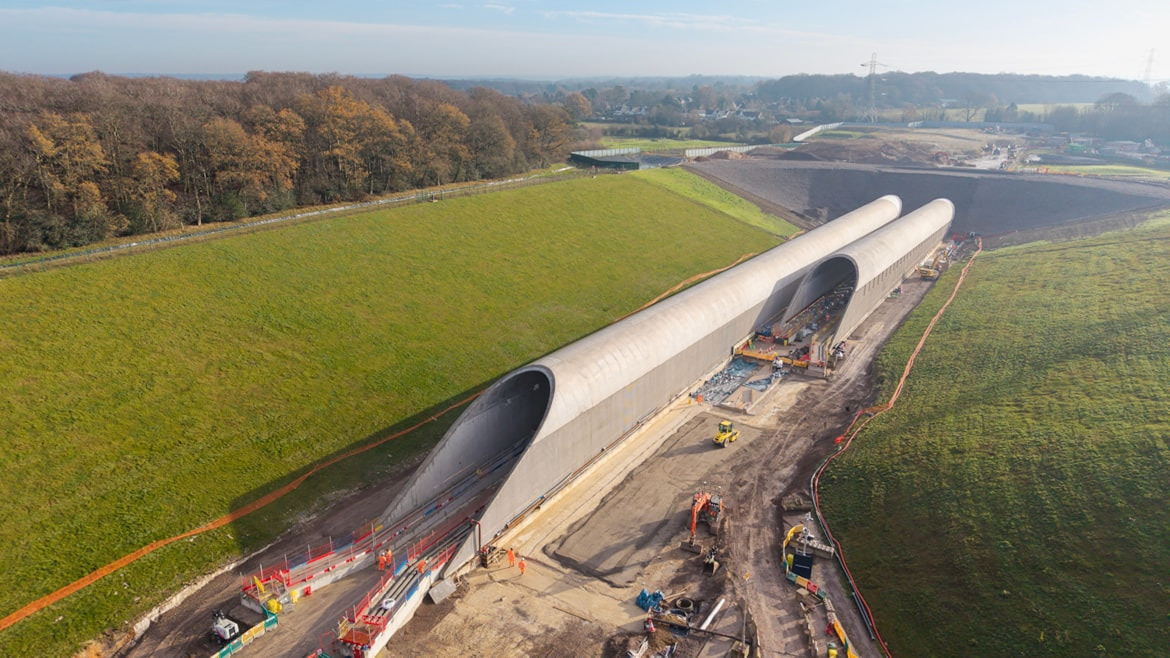

Engineers working on HS2’s Chiltern Tunnel have completed a key piece of infrastructure at the northern end of the route, finishing construction of two large portal extensions designed to manage air pressure as high-speed trains enter the tunnel. Known as porous portals, the structures sit near Great Missenden in Buckinghamshire and mirror identical installations completed earlier this year at the tunnel’s southern entrance.
The portals are a bespoke solution to a problem unique to high-speed rail. When trains travel at up to 200mph, the air they force ahead of them can generate powerful pressure waves inside tunnels. Without mitigation, those waves can exit the far end as an audible thud, often referred to as a sonic boom. While such micro-pressure waves are negligible on conventional railways, they become more pronounced at very high speeds, requiring tailored engineering to control them.
Each of the Chiltern Tunnel’s portal extensions stretches between 135 and 220 metres in length and features a series of ventilation openings along one side. These portholes allow some of the displaced air to escape gradually as trains enter the tunnel, preventing a sudden build-up of pressure and ensuring that any wave released at the opposite end is undetectable.
Construction of the northern portals marks a milestone for Align, HS2’s main civil engineering contractor for this section of the route. After completing the southern portals in January 2025, the same team moved directly on to the northern structures, carrying lessons learned from the first build. That continuity proved decisive, cutting construction time from around 20 months to just 12 and contributing to wider efforts across HS2 to improve productivity following a major programme reset.
The Chiltern Tunnel itself is a central feature of the London to Birmingham route. At 10 miles long, it is the longest of five twin-bore tunnels planned for the line. Once operational, passenger trains are expected to pass through it in roughly three minutes. HS2 Ltd says the completed railway will significantly reduce journey times between the UK’s two largest cities while releasing capacity on the West Coast Main Line for additional freight and local passenger services.
Despite progress on sections such as the Align works, HS2 acknowledges that other areas of the programme remain behind schedule. The project is now undergoing a wholesale review led by chief executive Mark Wild, with the stated aim of delivering the railway as efficiently as possible and at the lowest reasonable cost.
Mark Clapp, HS2 Ltd’s head of civils, said:
“I am extremely proud of the team because they rose to the challenge of constructing these unique porous portals at the Chiltern Tunnel’s southern end – and then built on the experience to do even better by delivering identical structures 10 miles to the north in a little over half the time. They have clearly demonstrated the benefits that flow from retaining skilled people by providing a steady stream of work because this helps drive efficient project delivery – in short, they haven’t had to reinvent the wheel.”
Align’s porous portal lead engineer Jean-Lou Grenard said:
“The porous portal team at Align has demonstrated exceptional commitment and expertise over the past three years. By embracing collaboration and actively applying lessons learnt from the construction of the south porous portals, we have significantly enhanced productivity during the build of the north porous portals. These achievements not only highlight the team's dedication to continuous improvement and innovation, but also set a benchmark for knowledge-sharing on future projects.”
Image: HS2
Related Stories