On This Day in 1892, Esholt Junction Rail Crash

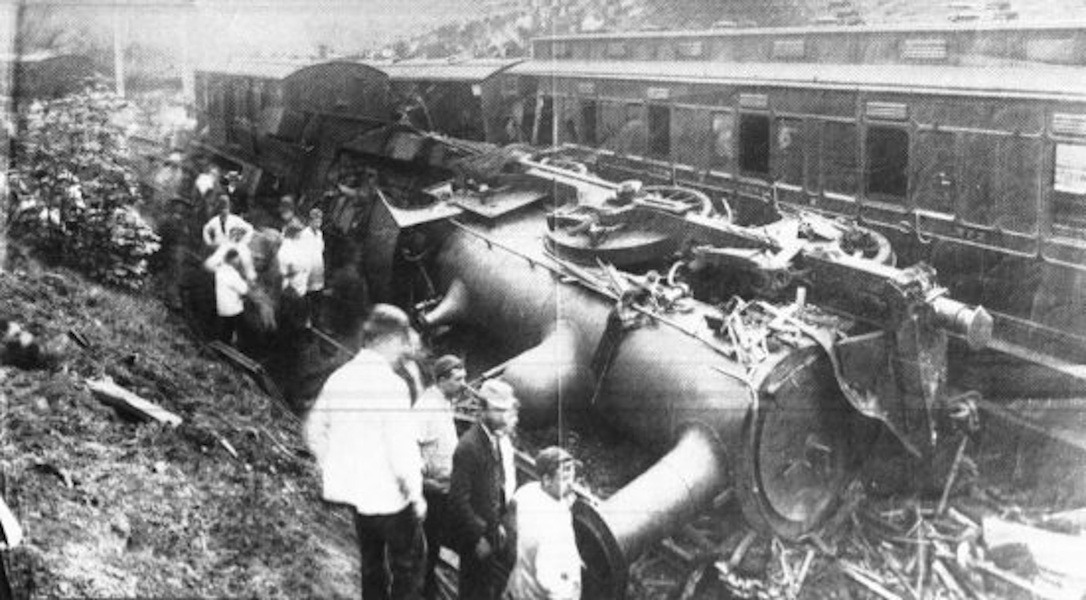
On this day in 1892, two passenger trains collided at Esholt Junction in Yorkshire, killing five passengers and injuring 26 passengers, along with four railway staff. The crash happened at 3.34pm on Thursday 9 June at the point where the Otley and Ilkley Joint Railway divided, with one route leading towards Leeds and the other towards Bradford. It was a busy junction close to Guiseley, and the accident exposed serious weaknesses in both signal visibility and the signalling practices then being used to manage converging train movements.
The collision occurred as several trains were approaching the junction in close succession. One of the key services was the 3.10pm Ilkley to Bradford train, which was crossing the junction. Another was the 3.07pm Leeds to Ilkley train, approaching from the Leeds branch. A Bradford to Harrogate train was also part of the wider sequence of movements through the junction. The timetable and train movements were not unusual for the location, but they depended on drivers being able to read the correct signals clearly and on the signalling system keeping conflicting movements safely apart.
Signalman Harry I’Anson, working in Esholt signal box, gave the Bradford to Harrogate train permission to pass the junction. At the same time, signalman Thomas Aubrey at Apperley allowed the Leeds to Ilkley train to proceed towards Esholt under a procedure known as clause 16. That arrangement permitted a train to approach in circumstances where it was expected to be stopped by a danger signal before the junction itself. It was a system that left little margin for error when more than one movement was being managed at the same time.
The driver of the Leeds to Ilkley train, Archibald McLay, mistook a proceed signal intended for the Bradford to Harrogate train as applying to his own route. His own signal was at danger, but it was obscured by vegetation when he looked towards it. By the time his train reached Esholt Junction, the Ilkley to Bradford train was already crossing ahead of him. The Ilkley-bound train struck the rear portion of the Bradford-bound service, turning a routine junction movement into a fatal collision.
The impact was severe. The Leeds to Ilkley train ploughed through the last six carriages of the Ilkley to Bradford train, overturning the last of them, while the engine and tender of the Ilkley-bound train also overturned. Five passengers, all on the Ilkley to Bradford train, died as a result of the collision. Twenty-six passengers were injured, along with McLay, his fireman Walter Bolton, the guard of their train and one of the guards on the Bradford-bound service.
Remembered today, 134 years on, the Esholt Junction rail crash stands as a clear example of how obscured signals and unsafe operating procedures could turn ordinary junction working into disaster. The Board of Trade investigation accepted the obscured signal as the immediate cause, but also criticised the signalling arrangements that allowed trains to approach the junction simultaneously under clause 16. The recommendation that the practice be abolished, and that the signal layout be changed, reflected the central lesson of the crash: at a busy junction, safety depended on signals being visible, unambiguous and backed by procedures that did not invite fatal misunderstanding.
Related Stories