Why Rail Is Still Paying the Price for Expensive Money
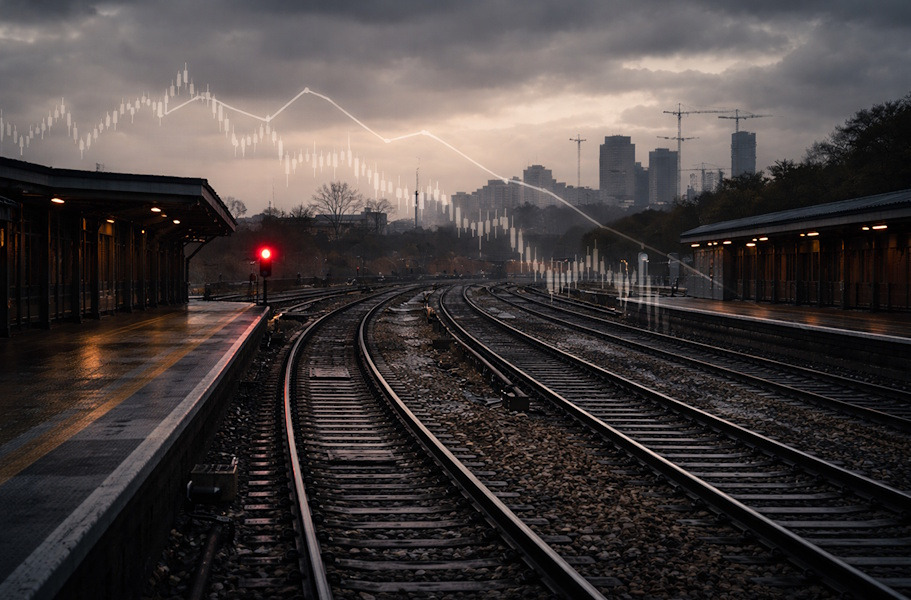

The Bank of England’s decision to hold interest rates at 3.75 per cent reflects a cautious pause rather than a clear turning point in the economic cycle. While inflation is forecast to ease further later in the year, policymakers remain wary of moving too quickly. For Britain’s railways, however, the announcement serves as a reminder that the consequences of the high interest rate period are already embedded, regardless of what happens next.
Rail infrastructure depends on long-term certainty more than most sectors. Projects are planned over decades, funded through extended spending settlements and underpinned by borrowing that assumes stable economic conditions. When interest rates rise and remain elevated, the effect is not always immediate cancellation but hesitation. Schemes become subject to reassessment, timelines are stretched and scope is quietly reduced. Over time, this creates a network caught between ambition and affordability, where delay itself becomes the default outcome.
These pressures extend beyond major infrastructure programmes. Train operators and rolling stock leasing companies operate within financial models that are sensitive to borrowing costs. Higher rates make new fleet orders harder to justify and encourage life extensions for existing trains. Refurbishment and replacement decisions are deferred, not abandoned, storing up future challenges around reliability, capacity and environmental performance. While such choices may make short-term financial sense, they narrow the margin for improvement across the network.
Network Rail’s own financial position illustrates how constrained the system has become. Maintaining and renewing an ageing railway within a fixed funding envelope has proved increasingly difficult, with spending pressures outpacing original plans. This does not mean interest rates are solely to blame, but they form part of a broader environment where efficiency gains are harder to achieve and tolerance for risk is lower. The result is a focus on managing decline rather than delivering transformation.
For passengers, the link between monetary policy and everyday rail services is rarely explicit, but it is real. Decisions on fares, subsidy levels and service enhancements are shaped by what governments believe they can afford over the long term. When ministers speak of difficult trade-offs, those choices are often framed by economic conditions that prioritise restraint. The cumulative effect is felt in slower upgrades, older trains and limited capacity growth.
Even if interest rates begin to fall later in the year, the railway faces a deeper challenge than borrowing costs alone. Confidence has been eroded by repeated policy changes, shifting priorities and uncertainty over long-term commitment. Lower rates may improve the financial backdrop, but they will not automatically restore belief in a stable pipeline of projects. The Bank of England’s decision may signal steadier conditions ahead, but for Britain’s railways, the legacy of expensive money is likely to linger.
Related Stories