The Fire Next Door: Why Glasgow Central Is Still Closed A Week Later
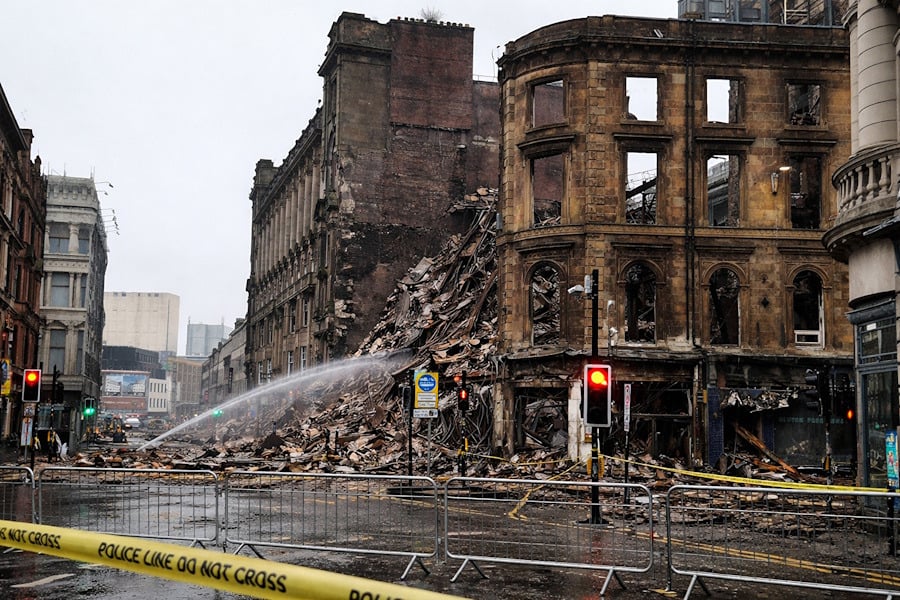

One week after a devastating fire tore through a historic building beside Glasgow Central, Scotland’s busiest railway station remains largely closed despite appearing to have escaped serious damage. The blaze broke out at around 3:46pm on Sunday 8 March in a vape shop on Union Street before rapidly spreading through a four-storey Victorian commercial building on the corner of Union Street and Gordon Street.
More than 200 firefighters and 18 fire engines were deployed at the height of the emergency as flames engulfed the building and threatened nearby landmarks including Glasgow Central station and the adjoining Grand Central Hotel. The fire caused catastrophic structural damage, destroying much of the interior and triggering the collapse of the building’s distinctive Victorian dome.
For many passengers looking at images of the aftermath, the situation has been confusing. Glasgow Central itself appears largely untouched, with its famous glass train shed and main concourse seemingly intact. Yet a week after the blaze, the station’s high-level platforms remain closed and services across Scotland’s rail network are still disrupted.
The explanation lies not within the station itself, but in the dangerously unstable remains of the building that burned next door. Large sections of the structure collapsed during the fire, leaving only parts of the façade standing along Gordon Street. Engineers have warned that further collapses remain possible, particularly as debris continues to shift inside the ruined shell.
Because of this instability, a wide safety cordon has been placed around the site, extending into the immediate approaches to the station. Network Rail engineers have also been unable to carry out full inspections of nearby railway infrastructure while the structure remains at risk of collapse. Until demolition and structural stabilisation work is completed, large areas around the station cannot safely reopen.
There are also concerns about potential hidden impacts caused during the firefighting effort. High-volume pumps were used to draw water from the River Clyde to fight the blaze, while heavy debris fell close to railway infrastructure. Engineers must now carefully inspect the surrounding structures before confirming that the station can safely handle passenger services again.
Some rail services have begun returning to the underground low-level platforms after safety assessments, but the main high-level station remains closed while the dangerous remains of the neighbouring building are dismantled. Until the site is fully stabilised and inspections are complete, Glasgow Central’s reopening will depend less on the station itself and more on the unstable ruins standing just metres away.
For passengers frustrated by the prolonged shutdown, the reality is that the railway station survived the fire. What has kept Scotland’s busiest transport hub closed for days is not damage to the railway, but the lingering threat posed by a gutted Victorian building still standing beside it.
Related Stories